Welcoming A Guest Author
My First Guest Author
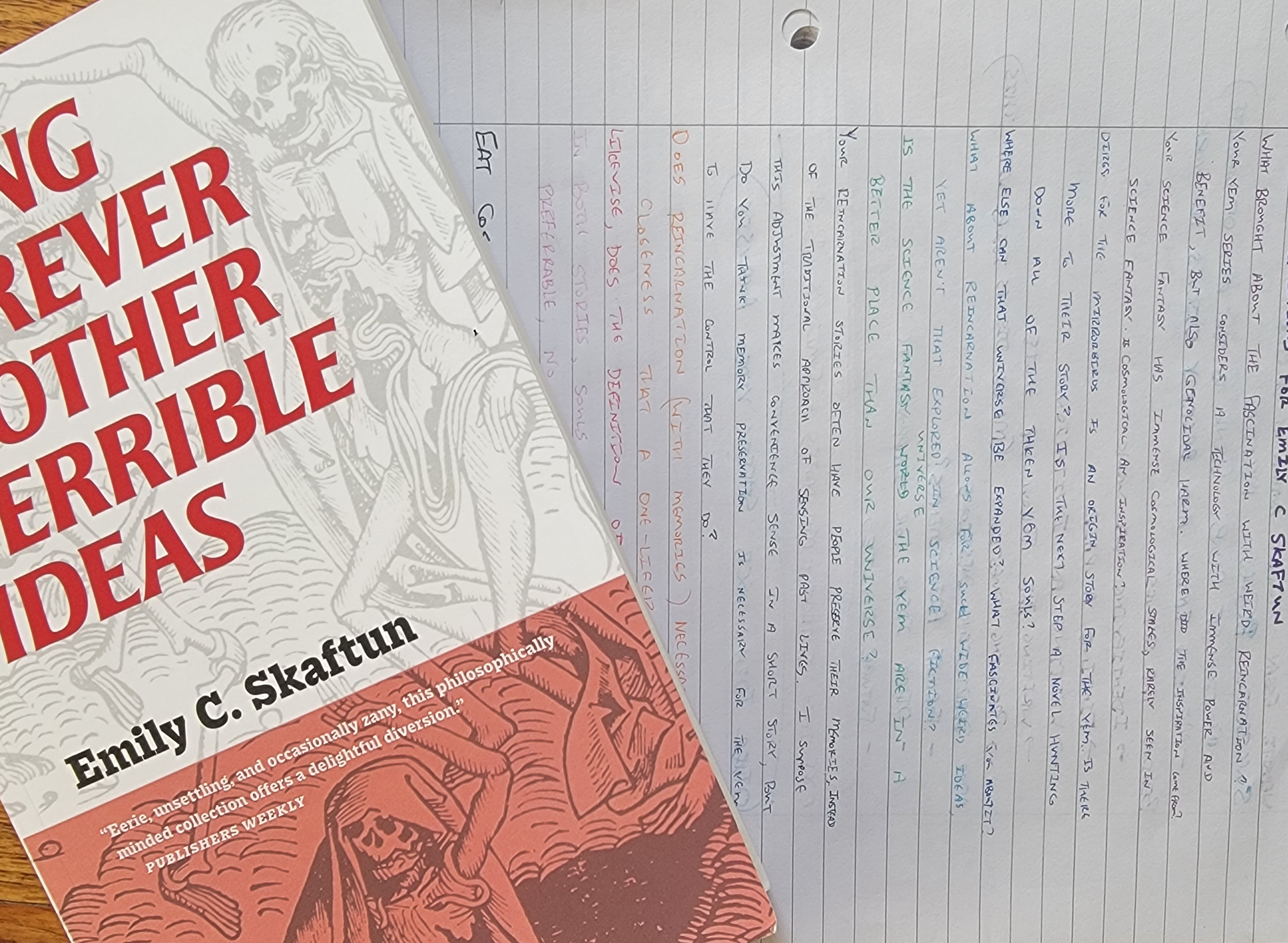
Recently, the SF Club welcomed author Emily C Skaftun to our discussion group.
I and the rest of the SF Club thank Emily C Skaftun for joining us to discuss her work “A Dirge For The Mirrorbirds”. Emily has been publishing fantasy and science fiction for well over a decade, often with a focus on strange, cerebral concepts. In her collection of short stories titled Living Forever & Other Terrible Ideas she explores ideas of life, death, and reincarnation in thought-provoking ways. “A Dirge For The Mirrorbirds” is an origin story in a science-fantasy universe where creatures remember their past lives on other planets but cannot reach their former homes due to the gigantic expanse of the universe. It packs in some big ideas as it explores identity, love, death, and exploitation.
The members of the SF Club thoroughly enjoyed Emily’s presence as she clarified some points, discussed other ideas she had in her vast and imaginative fictional universe, and answered our many questions about how she developed the story and where her writing was now going. Our club thanks Emily for dedicating the time and energy to answer our questions and listen to our conversation.
The process of inviting Emily as a guest took some time and effort and ended up paying off greatly. In this News piece, I take a look behind the scenes at how I developed the group so that I could bring aboard a guest author and share some of my thoughts for future meetings.
Behind The Scenes
A Long-Held Goal
When I was given the reigns from the prior leader, I spent an effort getting the hang of the position. I dug into modern science fiction magazines,1 read several novellas, researched recent science fiction films and television shows to find quality content. I also read criticism and researched award nominees to get an idea of what people were talking about.2 Over time, I got better at note-taking and identifying ideas that could generate discussion. I started collecting a list of winners, stories that generated plenty of conversation, and have been trying to use those data points to identify other works that the group will love. I have also been active trying to recruit more members and get other members to recruit members. All of this work has led to success as the group now has a greater average members per meeting than ever before.
These developments have led me to reach for a goal that I’ve been striving toward for many years: inviting guest authors. Back before the club existed, I visited my friend’s science fiction club in Beijing. Their discussion included the author of the short fiction piece, and I was surprised at how engaged the audience was in their conversation with the author. Later, when my friend started the science fiction club, he invited a guest author and, again, the reception and level of conversation was greatly elevated. Now that I had a steady group of members and a decent idea as to which topics and stories to choose, I felt I could try to do the same.
Even though our club had been around for a long time–well before the pandemic–because we never gave the club a name and we still used Google Meet and email BCC lists to schedule meetings there was a little lack of legitimacy. As I’ve expounded before, the motivation to design this website was a confluence of factors. One of them was establishing our club as… well… maybe not official but at least something that could assure strangers that it was real. The page that now exists is now enough to provide that solidity, enough to suggest some legitimacy.
With a website established, I selected an author from an upcoming piece I wanted to feature in the club. I wanted one who would likely accept, so I chose to invite an author somewhere in the US or Canada that could meet at 9 PM EST on a weekday night (which is 6 PM PST, thus reasonable for west-coasters as well as east-coasters). I also selected Emily because her story has some of the biggest ideas I’ve seen in a story in recent memory, and the people in my club love discussing big ideas.
Next, I needed to write an invitation. Fortunately, I have considerable training doing this, as one of my main duties when I was a Managing Editor was asking scientists to write papers or lead conferences or peer review papers or do other important work that an academic journal for a major scientific society may need. I have learned (through trial and error as well as much helpful advice from colleagues and mentors) the Art of the Invitation, and I shall share it with you here:
An Invitation’s Composition
Invitations need to have:
-
A description of you or your organization.
-
A description of why you are interested in this particular person, with as much specificity as possible.
-
A description of why you think this particular person should agree to the invitation.
-
If necessary, words that assuage any major hang-ups the person may have.
-
A conclusion that states a precise call to action.
All of this needs to be as brief as possible so as to not waste the time of the recipient.
The invitation needs to be freshly written and personalized for each recipient. It’s easy to crank out a form invitation and mass-send hoping that casting a wide net yields fruitful results. People tend to sniff out mass messages and in an era where everyone is bombarded with advertising at all times even well-intentioned mass messages will get ignored. Personalized messages remain rare for the average recipient that they float above the noise.
1. A description of you or your organization
This first point should be the first sentence of the message. If you are part of an organization, then the sentence will likley include both yourself and your organization. Most of the time you don’t need to immediately explain all of the inner workings of your organization, especially if the title of the organization makes what they do self-evident. In those exceptions, try to be as brief as possible in explaining what it is your organization does.
2. A description of why you are interested in this particular person, with as much specificity as possible.
I won’t deny that a little flattery goes a long way. But the main purpose of this description is to set your request apart from others they may have seen by showing the specifics of what makes what they do of interest to you.
3. A description of why you think this particular person should agree to the invitation.
Many people who send invitations miss this important step. Not merely is it important to show your interest in them, you should also have them understand why they should be interested in you. I wouldn’t make this section long as it will sound like a sales pitch, but I would not discount the impact of having your reader self-reflect on what they benefit from accepting your invitation even if those benefits should seem obvious to you.
4. If necessary, words that assuage any major hang-ups the person may have.
Frame these points as details to your invitation and not counterarguments to some existing debate. For example, when inviting an author to our SF Club, I mention that the author can answer questions and be engaged with the audience or just do a Q+A with me if that makes them more comfortable. Often these statements are about highlighting flexibility the invitee has to offer. One to highlight here is if there is flexibility on time. People are often busy and so fitting things into a schedule can be challenging; highlighting flexibility on time can make you look like you gave proper consideration.
5. A conclusion that states a precise call to action.
I prefer highlighting the call to action in bold. Any email over five sentences has a decent chance of being glanced over and so highlighting what precisely it is that you want, in as terse but friendly and professional language as possible, ensures that the reader at least picks up on what it is you want before finishing their skimming is complete. Be clear about what you want: a common error I’ve seen is when people write an invitation and it isn’t clear enough, leading to an awkward back-and-forth with the recipient.
After the Acceptance
Once a person has accepted an invitation, you should send a follow-up as soon as possible. Unlike the invitation, which needs to be fresh and tailored, the follow-up message should be formal and instructional. A good follow-up message should assure the recipient that everything has been planned out and streamlined so that there’s little friction on their end. I like to mention wherever possible places of flexibility and places where the recipient can contact me so we can make adjustments. Don’t expect recipients to read every detail but have enough details there that they have confience in your capabilities.
The third and final message the recipent should receive should be after the event, as a thank you note. There are plenty of resources out there on how to write a good thank you note. My advice is to keep it simple and personal.
Lessons Learned
I’m excited by how much of a success this event ended up being. Members of the club were highly engaged and the invited author appreciated the appreciation and attention her work was getting.
That said, I think such an event would have to be at best quarterly if not only semi-annually in order to deal with the amount of behind the scenes work to pull everything off. In the meantime, I’m going to attend more Q+A sessions at the local independent bookstore’s author events.3 I tried to emulate the excellent host of those events and ask similarly insightful questions, but I think I could still use more experience.
Overall, what a phenomenal event! Thank you Emily and the members of the club.
-
Shout out to Rocket Stack Rank, a fan-created set of lists of the major science fiction magazines. ↩︎
-
Shout out to Asking the Wrong Questions. Even though I don’t use many of the works Abigail recommends, I learn a lot from how she approaches speculative fiction. ↩︎
-
Joseph Beth Books is an outstanding independent bookstore. ↩︎